
Why you need to manage value
That starts with knowing where value actually comes from. Most teams point to the outputs delivered, what's shipped, or the budget spent. Value actually comes from the business problem underneath. No use case, no value, which is why value management has to be a discipline: governing the business context up front and professionalizing the business use case.

One metrics foundation and one estimation method make every use case comparable on the same terms, whoever built it.
Every value number carries its assumptions and a business report, so estimates can be challenged, defended, and revisited with confidence.
See which initiatives and AI solutions create the most value, with business impact lineage from metric to outcome.
The framework
The steps stay the same every time: settle on the metrics, put a number on the expected impact, then check that number against what actually happened.
Define the metric set to focus on and calculate value potential against.
Aggregate expected impact across metrics into a comparable monetary value.
Aggregate impact across the portfolio to steer investment effectively.
Track changes in the metrics and attribute realized impact to the initiatives behind it.
How teams manage value in Mindfuel
Each step of the framework is facilitated in Mindfuel, from qualification
through tracking to reporting so you can prove the value from your investment.
Metrics Store
When each team picks its own metrics, value can't be compared across the portfolio. The Metrics Store manages metrics centrally, links use cases to the metrics they move, and sets target values, so value potential is quantified consistently and adoption can be tracked from day one.

Central metric management for consistency and comparability across teams
Use cases linked to metrics with target values that quantify value potential
Adoption metrics tracked early for a first read on value realization
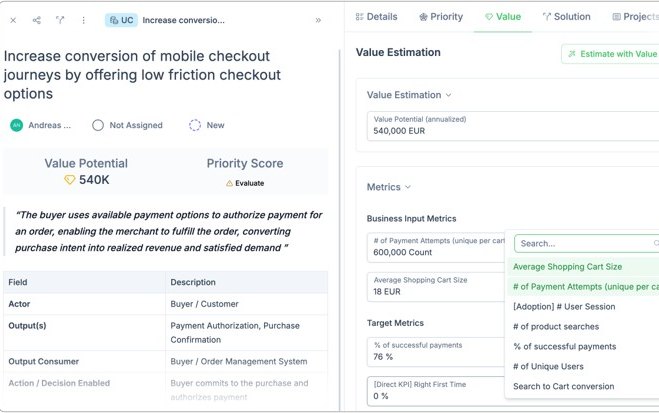

Value Estimation
Estimates built on different assumptions can't be compared and don't survive scrutiny. Value Estimation quantifies monetary impact from the selected metrics, documents and shares the assumptions behind every number, and produces a business report, so estimates are comparable, traceable, and auditable.
Monetary impact quantified from selected metrics for comparability
Assumptions documented and shared for consistent calculations
Business reports that make every estimate traceable and auditable
Impact Studio
Without a portfolio view, teams overstate isolated wins and miss cannibalization between initiatives. Impact Studio shows which metrics are affected, visualizes which initiatives contributed, and which AI solutions are most valuable, and contextualizes impact through clear use case stories.
Overview of impacted metrics to avoid cannibalization between initiatives
Visual insight into which initiatives contributed and which AI solutions deliver most
Value contextualized through clear use case and success stories


Value Manager
When impact can't be attributed, credit gets contested, and trust erodes. Value Manager tracks impact on individual metrics to evaluate success and aligns attribution, so the contribution of each initiative and AI solution is clear, building stakeholder trust and continuous learning.
Tracks impact on individual metrics to evaluate success
Aligns attribution across initiatives and AI solutions
FAQs