
Every few decades, a new technology emerges that doesn’t just change how companies operate. It redefines what a company is.
The computer did that. The internet did that. Before them, electricity did. Each wave rewired the foundations of business: how information flows, how people work, and how value is created. These moments are rare and unmistakable when they happen.
AI is one of those moments. It’s not just another tool to add to your tech stack or a new department to staff up, but a new organizational operating system. AI is reshaping how people collaborate, how decisions are made, and how products come to life. It changes the team structures, work rhythms, and the nature of innovation itself. Instead of sitting at the edge of the company, it moves into its core. And that core defines a new kind of organization: the AI-native enterprise.
A rare kind of transformation
Just as no company today could survive without computers or the internet, soon none will stay competitive without becoming truly AI-native.
The difference between those companies that adapt and those that don’t come down to access to technology. They come down to mindset, structure, and speed of learning. To be AI-native means rethinking the company from the inside out: its workflows, its talent, and its culture of experimentation.
For us at Mindfuel, this shift is deeply personal. It shapes our journey as a SaaS company. AI is transforming what we do, how we do it and redefining what we build. It shapes the products we design and the experiences we deliver. It influences every decision we make, from how we model data to how we serve customers. It’s not an add-on. It’s becoming the essence of our product.
"Others are wrapping old-school IT governance workflows around AI. Mindfuel was built for AI from the start."
The AI-native enterprise is the blueprint for survival and differentiation today. The companies that embrace it early will move faster, learn faster, and deliver more value to customers. Those that hesitate will find themselves in a world that's already moved on.
What makes a company AI-native?
If AI is the new operating system of the enterprise, the AI-native company is the organization built to run on it. To understand what that really means, imagine a pyramid – the AI-First Pyramid –that shows the four layers every company must strengthen to become truly AI-native.
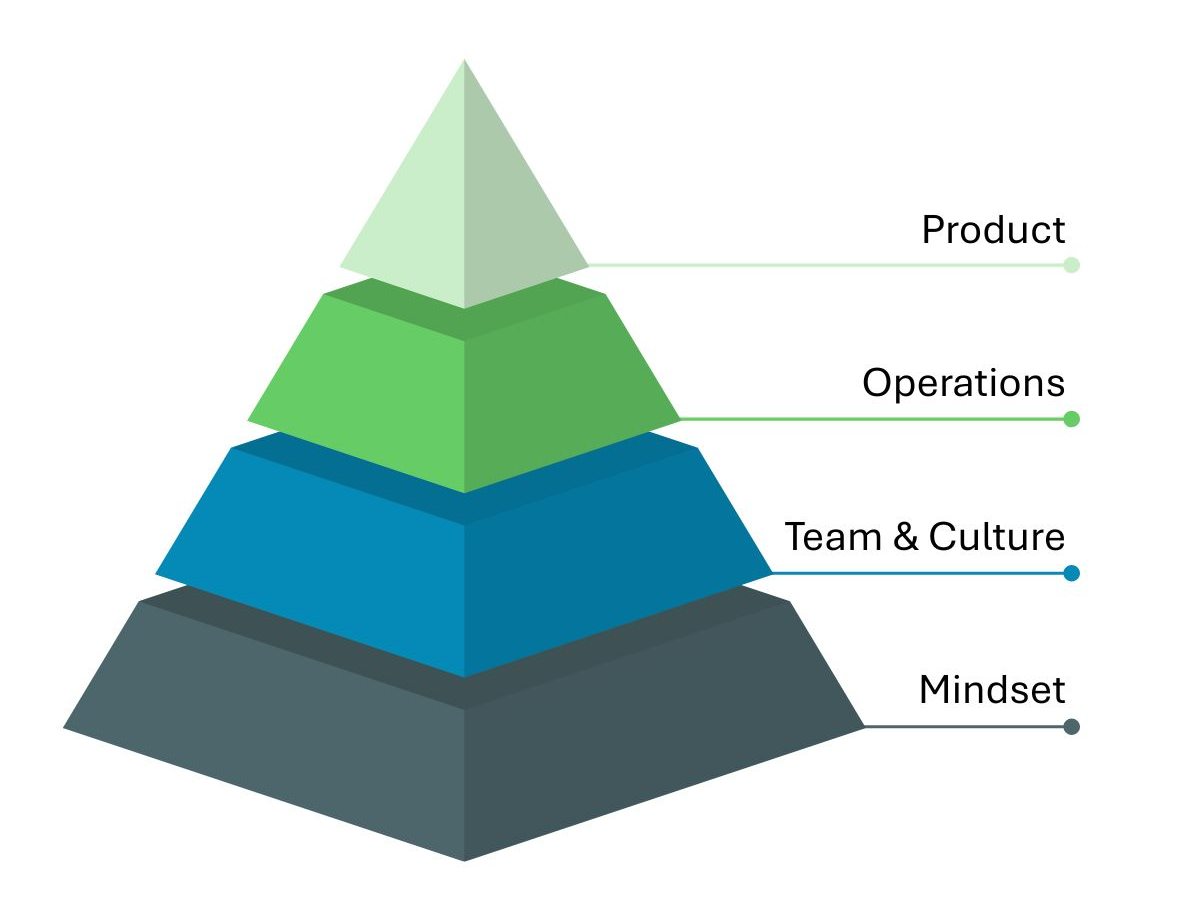
At its base lies Mindset. This is the conviction that AI is not a feature in your existing products or an add-onto your business model but actually a fundamental shift in how work happens. Without this belief, every initiative remains tactical.
Above mindset stands Team & culture. Culture turns belief into behavior. It defines how teams experiment, share what they learn, and adapt as they go. An AI-native culture rewards curiosity, accepts iteration, and sees failure as feedback. It breaks down silos between business and technical teams so that data, context, and decision-making can flow freely.
Built on that cultural foundation comes Operations. The processes and systems that make intelligence a living part of the organization. This is where data, automation, and decision frameworks are embedded directly into workflows. Operations translate intent into action: they ensure that insights move quickly from detection to decision to delivery.
At the top sits Product. This is the visible outcome of everything beneath. In an AI-native company, the product continuously learns from use, adapts to context, and delivers value that scales with intelligence. This natural outcome of an organization that has intelligence built into its very core goes beyond merely “AI-powered.”
When these four layers align, you get more than a technology transformation. You get an organizational transformation. The AI-First Pyramid isn’t just a model for how to build but shows where a company truly stands on its journey to becoming AI-native.
Also read: Designing AI Agents for Data-Driven Decision Making
How to become AI-native
So what does it mean to become AI-native in practice? The AI-First Pyramid shows the structure, but building it requires translating belief into behavior, and behavior into systems. Each layer becomes a set of choices leaders can make every day.
Mindset
To build an AI-native company, start with the mindset. Especially that of the leadership team.
AI can’t live in a corner of the organization. It’s a new way of thinking about value creation and not a department or a side project. The shift starts with leadership alignment – seeing AI not as a replacement of human labor, but as augmentation: a way to expand human capability, insight, and speed of learning.
Creating the right mindset also means building psychological safety around experimentation. Teams need permission to test and adjust in public, to learn from small failures without fear of blame. Without that, innovation freezes under the weight of caution.
Team & culture
Above mindset stands team & culture, where belief becomes behavior.
An AI-native culture rewards curiosity, iteration, and shared learning. Teams run short loops: experiment, measure, share, adjust. Success isn’t defined by always being right, but by learning faster than anyone else.
In AI-native cultures, boundaries between roles blur. Product managers understand model behavior. Data scientists understand user context. Both share responsibility for outcomes. This collaboration turns every release into a feedback loop rather than a product considered “finished”.
Operations
Once culture supports experimentation, the next layer is operations. This means embedding intelligence directly into the flow of work.
This is where AI stops being an idea and becomes infrastructure. Data systems connect across silos. Decisions are instrumented with feedback. Automation takes on the repetitive so humans can focus on what’s exceptional and creative.
Operational AI enriches process with context and precision. A human-in-the-loop approach ensures that judgment stays central, while AI accelerates detection, insight, and action.
Product
At the top of the pyramid sits product, the most visible expression of being AI-native.
An AI-native product learns from every interaction, personalizes experiences, and gets smarter over time. The best products evolve continuously, turning data into feedback and feedback into foresight.
Designing products that learn requires closing the distance between users and builders. Insights from usage feed directly into design and development. Instead of shipping versions, you ship learning systems that improve with each cycle.
Measuring maturity: From layers to waves
Becoming AI-native doesn’t happen all at once or all in one place. It’s tempting to imagine the journey as a ladder: you move from mindset to culture, from culture to operations, and finally to product.
But in reality, transformation spreads more like waves than a staircase. Each layer of the AI-First Pyramid still matters and still builds on the one below, but once the base is strong enough, progress ripples unevenly across the company.
Some waves crash early in certain areas (like product or data science), while others lag behind (like operations or leadership habits). That’s normal and often healthy. What matters is that the waves keep moving outward from a shared foundation.
Wave 1: Awakening (Mindset)
This is where the current starts. The company begins to see AI not as an experiment, but as an existential shift. Leadership alignment forms around a common conviction: AI is not a tool to adopt, but a capability to cultivate. Curiosity becomes strategy.
Just as mobile-first redefined how companies thought about user experience and cloud-first reshaped how they built and delivered technology, AI-first transforms how organizations think, decide, and operate. Without this shift, every other layer remains tactical because AI cannot take root in an organization that doesn’t yet believe in what it’s for.
Signals of Wave 1:
- Leadership connects AI to business outcomes, not just innovation theater.
- Teams feel permission to explore, test, and talk openly about AI.
- Curiosity replaces fear in conversations about automation and augmentation.
Wave 2: Translation (Culture)
Once the belief is in place, behavior starts to change. Culture becomes the translator between conviction and capability, turning ideas into motion. Teams start sharing learnings, celebrating experiments, and designing work around short feedback loops. This cultural rewiring creates psychological safety, the hidden infrastructure of innovation.
Signals of Wave 2:
- Teams own the outcomes and measure learning speed, not just output.
- Failures are documented and discussed publicly.
- Collaboration between technical and non-technical roles increases, and sometimes even blends into the same roles.
Wave 3: Integration (Operations)
With a learning culture in motion, intelligence begins to flow through systems as processes evolve from static checklists to adaptive frameworks, data becomes connective tissue linking what teams know to how they act, and automation and augmentation merge to free humans to focus on what judgment does best: context, creativity, and care.
Signals of Wave 3:
- Workflows instrumented with data and feedback loops.
- Decision frameworks informed by live insights.
- AI tools assist daily work beyond analytics, in planning, forecasting, and design.
Wave 4: Expression (Product)
Finally, intelligence becomes visible through the product itself. Everything beneath comes to life as the product learns, adapts, and compounds value with each use. But crucially, this wave can only rise when the layers below are already moving. An AI-curious company can't leap directly to AI-native products without the depth of learning to sustain them.
Signals of Wave 4:
- Products continuously personalize and evolve.
- Feedback from users directly informs model behavior.
- Learning systems replace static features, every release becomes smarter.
- Leadership understands that in a non-deterministic world, value comes from outcomes, not just outputs.
The tide of maturity
Each wave builds upon and reinforces the others. When the first two are strong, the next two move faster. When culture or operations lag, product waves weaken. Maturity, then, is about momentum with depth and not uniform progress.
You don’t need every wave to peak at once. You just need them to keep rolling. Because that’s how an organization shifts from AI-curious to AI-fluent – not in parallel lines, but through living motion.
The age of intelligent organizations
The story of every technological revolution is also the story of human adaptation. The arrival of AI is no different, except for its speed. The pace at which intelligence embeds itself into every layer of work is unlike anything we’ve seen before. What once took decades – to electrify, to digitize, to connect – now happens in months.
For leaders, that acceleration is both a gift and a test. A gift because AI expands what’s possible. A test, because it demands a new kind of fluency in transformation, not just tools.
The companies that will define the next decade won’t just use AI; they’ll speak its language fluently. They’ll build products that learn, teams that adapt, and systems that evolve on their own. They’ll operate as living organisms, sensing, thinking, and improving in real time.
Becoming AI-native doesn’t mean chasing the latest models or automating every task. It means building an organization that learns as fast as it acts, where curiosity outpaces fear and experimentation outpaces certainty. Intelligence lives in the DNA of the company, not just in a department.
“AI is not what Mindfuel does. It is how Mindfuel works.”
We’re still at the beginning of this journey ourselves. At Mindfuel, we’re learning what it means to become AI-native with every product decision we make, every workflow we redesign, every experiment we run.
The patterns are emerging, but they’re far from settled. And as Roy Amara famously put it, “We tend to overestimate the effect of a technology in the short run and underestimate the effect in the long run.”
That truth feels more relevant than ever. What we do know is that the gap between companies that are genuinely transforming and those that are just experimenting is widening faster than most people realize.
The question isn’t whether to become AI-native. It’s whether you’re moving fast enough to keep up.