
I had the pleasure of joining Doug Laney on EM360Tech’s Don't Panic, It's Just Data podcast series to discuss a challenge that keeps coming up in conversations with data leaders: How do you actually demonstrate the business impact of data and AI initiatives?
It's a question that sounds simple but has proven remarkably difficult for organizations to answer. Everyone agrees that value from data and AI is at the top of the agenda. Conferences I’ve attended are filled with talks about its importance. But when it comes to connecting the dots between data efforts and measurable business outcomes, most organizations struggle.
Through our work at Mindfuel and years of research into this problem, we've identified what we believe is the missing piece – and it's not what most people expect.
Why data and AI investments fail: the bottom-up problem
Over the past several years, we've explored why organizations find it so difficult to deliver ROI from data and AI initiatives. Our conclusion is that almost everyone starts bottom-up, beginning with the data side of the house instead of top-down from business problems.
Organizations build platform layers –what’s called the analytical plane – then they add metadata layers on top to keep structure around their data platforms. But here they usually stop. Some of the platform players try to provide what they call an “AI governance layer” on top but that doesn’t solve the problem. Conceptually, they try to jump directly from metadata to business demands, and that gap is where value gets lost.
What we've identified is the need for an additional layer between business strategy and data platforms: the value layer.
What is the value layer?
The value layer addresses three critical problem statements:
- What data initiatives actually exist and which business problems do we have? Many organizations lack clarity on what problems they're trying to solve and where initiatives originate.
- Which data and AI assets are needed to address those problems? Coming from the business demand side, we need to understand which assets can be reused to solve business problems.
- What business value can we generate from these endeavors? We need a robust yet accessible methodology for value management.
This layer sits between business demands and platform layers, creating a bridge that's been missing.
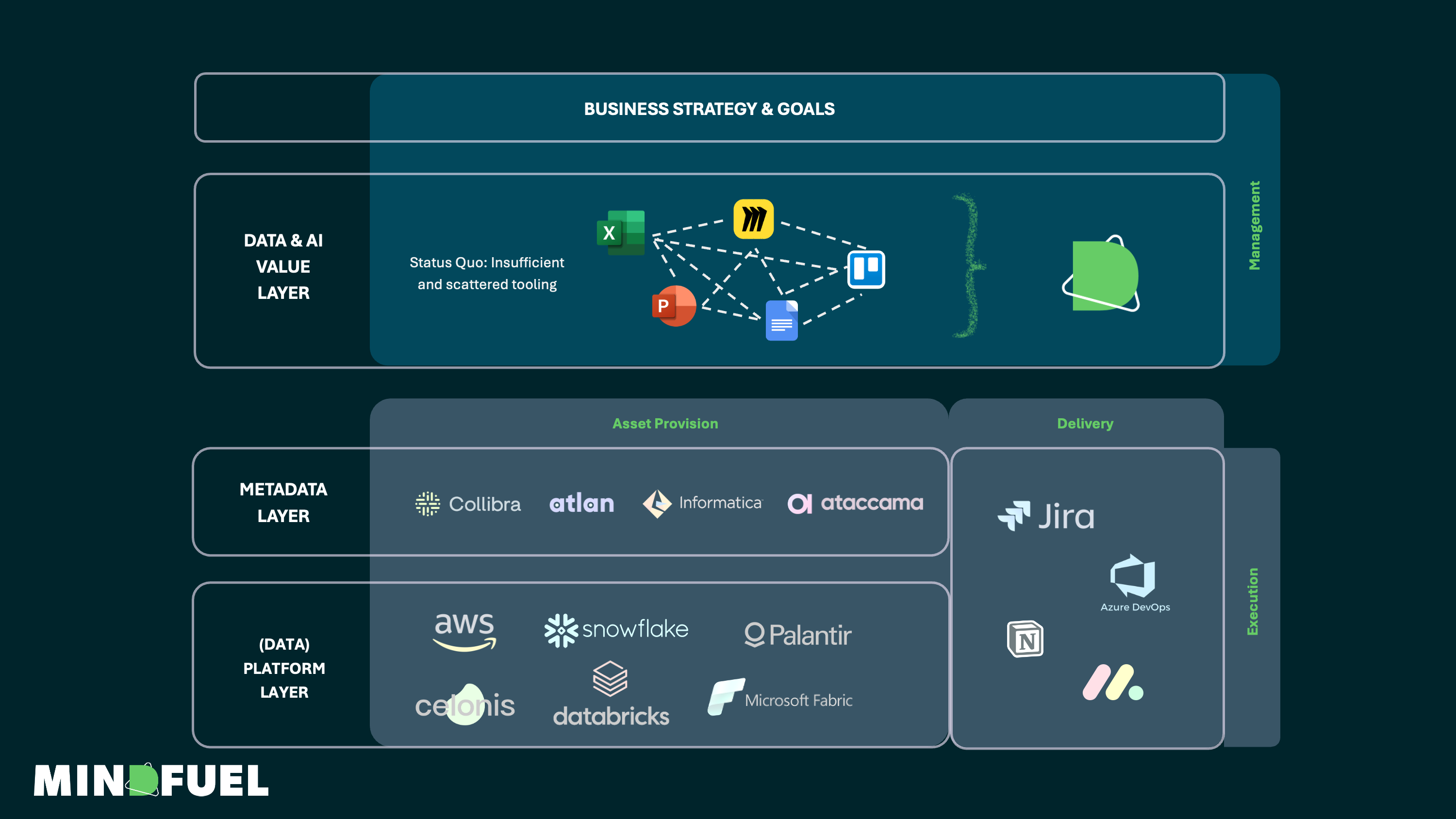
From data-first to problem-first: starting with business use cases
The value layer fundamentally changes how companies approach data and AI. Instead of starting from the data side and asking "which data products can we build?" – we start from the business side and ask "which use cases do we actually have?"
The process begins with structured, systematic demand exploration. We have to truly understand the actual business problem. We need to qualify the demand, conduct proper use case management, assess business value, and establish clear prioritization. Only after that do we proceed to solution design, focusing on reusing existing assets.
This approach bridges the business world and the data and AI world, making business stakeholders owners of the process from day one and transforming data teams from cost centers into measurable value drivers.
How to demonstrate value from data and AI: the complete lifecycle
Value management isn't just about the end result and spans the entire lifecycle from qualifying initiatives to tracking and validating outcomes. We've identified a clear lifecycle, which is represented in a nutshell:
1. Value qualification
Assess the value potential of each initiative, which feeds into prioritization by providing a clear, comparable basis for deciding what should be tackled first. Think of the classic use case matrix with business impact on the y-axis and effort on the x-axis. Value qualification provides proper dollar values for that y-axis, moving beyond vague assessments of "high" or "low" impact.
2. Value tracking and monitoring
Track value across different dimensions – annualized, by product, or by solution. Crucially, you need to put value potential next to value realized. We've seen too many organizations where value potential is sky-high, but when you actually measure what was captured, it's a fraction of what was promised.
3. Value measurement
This has different facets. It can be a precise technical measurement, or it can involve approval from stakeholders like the controlling department. Someone needs to sign off and confirm the value realized. Our vision is to eventually do this in an AI-first way leading to data being activated as an asset on balance sheets in the future.
Data product management: delivering outcomes vs. outputs
Product management brings valuable methodologies and best practices to delivering outcomes instead of just outputs. The outcome is the value we deliver for the recipient of the output. If customers or consumers don't perceive the output as creating an outcome for them, we're missing the mark.
Product management in the data world means establishing best practices before developing anything. We ask four key questions:
- What is the viability?
- What is the desirability?
- What is the feasibility?
- What is the datability? (a term we introduced in 2021)
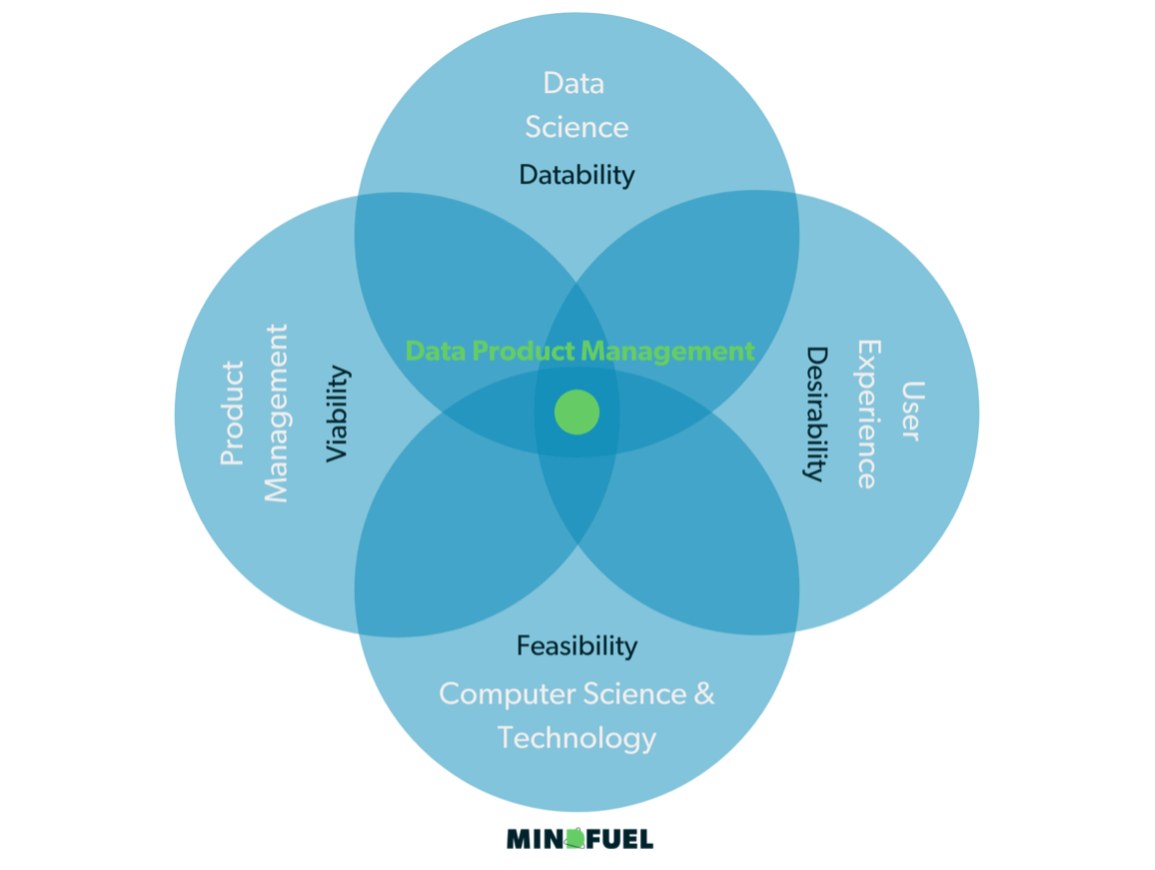
These dimensions should be qualified before we start development, done in close collaboration with internal business stakeholders. This is first doing the right things before doing things right. Doing things right is the delivery piece – we have great technical talent for that. But doing the right things and prioritizing to drive outcomes instead of outputs is where product management becomes essential.
Also read: Towards Data Science: Data Product Management
Beyond dollar values: measuring qualitative and quantitative impact
Not every use case has a direct dollar value. Some are foundational or enabling. They contribute to unlocking dollar value rather than generating it directly. This is why we frame it as "data and AI impact management" rather than just "value management".
We have both qualitative and quantitative KPIs. We have direct and indirect value drivers, leading indicators in the qualitative environment. When people hear "value," they immediately think dollars. But impact encompasses the broader set of metrics – some quantitative, some qualitative – that show how we're contributing to the business.
With our platform, Mindfuel, you can connect the dots between foundational data solutions and the business outcomes they enable. This works on both sides: on the data product side where enabling products contribute to business value through other products, and on the use case side where foundational problems are preconditions for unlocking million-dollar or even billion-dollar use cases.
Justifying data and AI investments: building the business case
With AI investments under intense scrutiny and tight budgets, impact management for data and AI becomes even more critical, especially for support functions like data, analytics, and AI teams.
We're only as good as the business teams we enable. Data and AI impact management creates transparency around the initiatives data teams are working on. We can demonstrate systematically how AI solutions contribute to the business. This transparency helps manage expectations more effectively because the value layer brings business and data and AI people together on one screen.
Data and AI impact management sets the foundation for budgeting, cost validation, and investment justification. Through roadmapping, we can show that three specific AI initiatives will contribute X million dollars to the core business, providing concrete justification for budget requests and demonstrating return on investment.
How to implement data and AI impact management
For data leaders looking to show measurable business impact and manage their data product lifecycle more effectively, were commend three steps:
Step 1: Install the product mindset
This has little to do with technology and everything to do with culture. Install a product mindset. Embrace outcome over output. Understand that value management is a key capability that needs to be established in your organization.
Step 2: Establish the value layer
Build this layer on top of your platform layers (data and metadata). Implement the workflow from demand management through use case discovery and solution delivery. This workflow starts with business ideas and ends with epics handed off to Jira or your execution environment of choice.
Step 3: Connect and activate
Link the value layer to your operating model. Connect upward to strategic goals to ensure prioritization aligns with strategy. Connect downward to technical platforms to drive asset reusability. When a new use case comes in, you can immediately see which existing assets can be reused – perhaps 60% can be leveraged, with only 40% needing new development. Then synchronize with your execution environment to activate these processes in daily operations.
The value layer builds the bridge from data initiatives to business outcomes
The conversation around data value has been ongoing for years, but translating it into measurable business impact has remained elusive for most organizations. The value layer provides the missing piece: a structured approach to bridge business strategy and data platforms, ensuring that every initiative starts with clear business problems and ends with validated outcomes.
Data and AI initiatives should be joint ventures between business and technology teams. The value layer builds that bridge, creating the transparency and accountability needed to unlock real business value.
Want to hear the full conversation? Listen to the full podcast episode →